How to get your Florida Boating Safety Education ID Card online in 2026
Get your Florida Boating Safety Education ID Card online in 2026. Step-by-step FWC requirements, course options, and Miami rental rules.

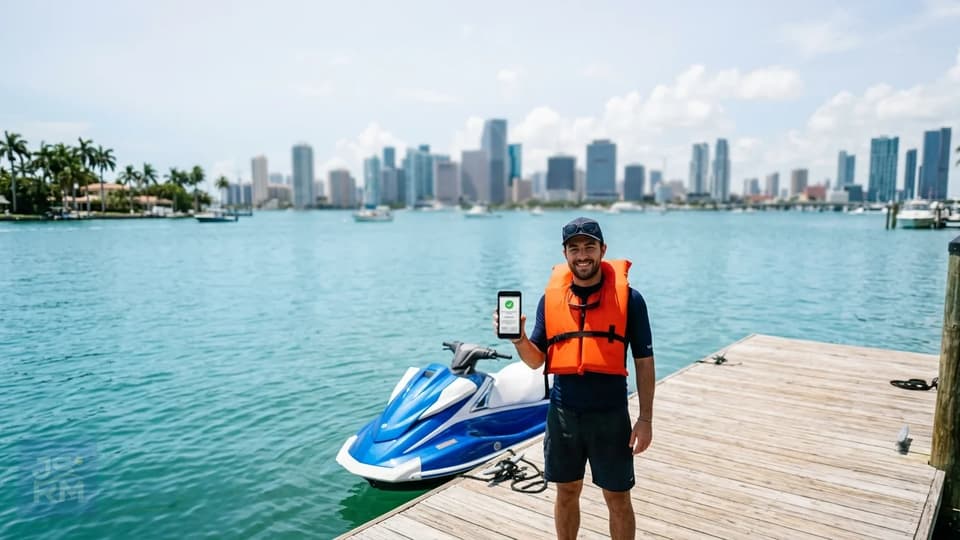
Planning your Miami water adventure? Discover our rent a jet ski in Miami or try our Miami jet ski tour experience.
If you plan to drive a motorboat or personal watercraft in Miami, you need to know state law before touching the throttle. Florida does not issue a boating license. Instead, the state issues the Florida Boating Safety Education ID Card. Under Fla. Stat. § 327.395, anyone born on or after January 1, 1988 must carry this card alongside a valid photo ID to operate any vessel powered by an engine of 10 horsepower or more on state waters.
Since launching Jet Ski Rentals of Miami in 2022, we've helped hundreds of guests navigate this exact requirement before their first ride. The most common surprise is that even a temporary card requires a real 25-question test. You cannot just click through.
Who needs the card
The law applies to both residents and out-of-state visitors. Whether you're running a center console out of Dinner Key Marina or booking a personal watercraft on Biscayne Bay, the 10 horsepower threshold means almost every motorized watercraft requires this card if you fit the age criteria.
Florida state law under Fla. Stat. § 327.39 sets the minimum age to operate a vessel at 14 years old, provided the person has completed an approved safety course. Private rental companies across Miami usually set their own minimum rental age at 18 or 21 years old due to insurance requirements. For personal watercraft specifically, the rental minimum is 18 by statute.
Temporary certificates vs permanent lifetime cards
You have two choices when getting certified, depending on whether you live in Florida or are visiting for a weekend trip.
A temporary certificate is aimed mainly at tourists and short-term renters. You take a brief exam online or directly at an authorized marina dock. A temporary certificate stays valid for 90 days from the date you pass the test. It gives you immediate access to ride, but once those 90 days expire, the certificate disappears and you must re-take the test if you return for another trip later in the year.
A permanent Florida Boating Safety Education ID Card never expires. Once you complete an FWC-approved course, your card remains valid for life. There are no annual renewal fees, no refresher tests, and no physical card replacement fees from the state. If you live in South Florida or visit Miami more than once a year, the permanent course is the smarter move. You do the work once, keep the digital card on your phone, and you're set for every future trip on the water.
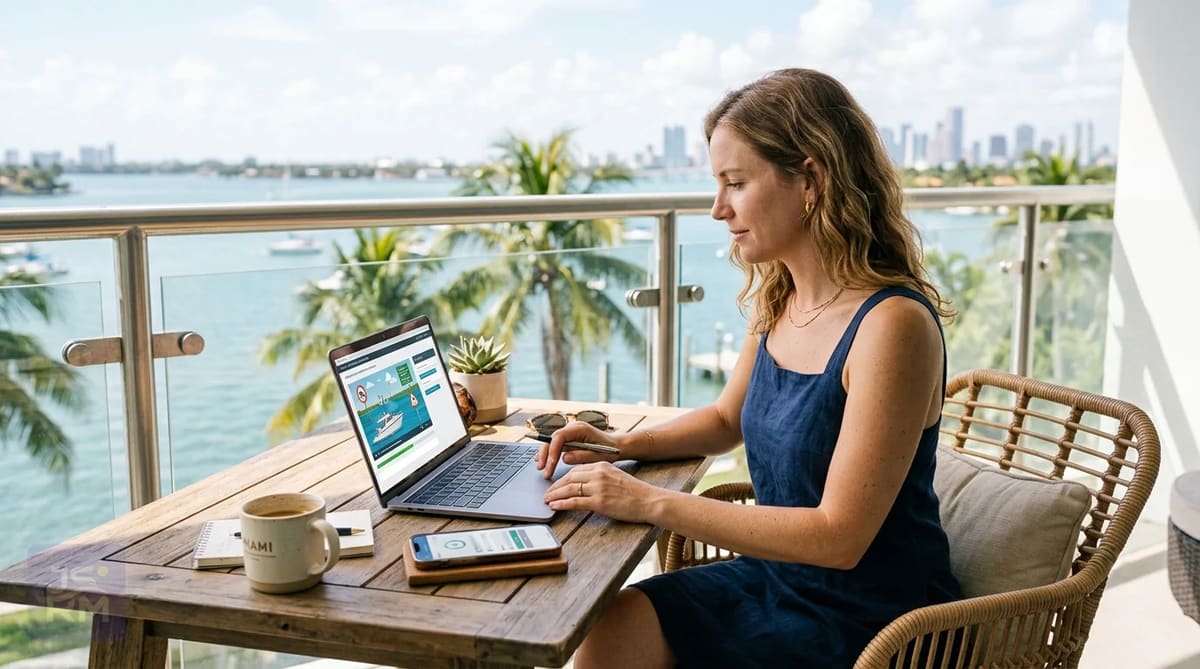
Step-by-step guide to getting your card online
Getting certified online is straightforward. The temporary certificate takes about 20 to 30 minutes. The permanent course takes between three and six hours depending on your pace. You can split the time across multiple days on your phone, tablet, or computer.
First, pick an approved course vendor. The Florida Fish and Wildlife Conservation Commission maintains a list of approved providers. Every listed provider holds accreditation from the National Association of State Boating Law Administrators (NASBLA).
Second, register your profile with accurate personal information. Your full name and date of birth must match your state driver's license or passport exactly. Law enforcement officers will compare both IDs if they stop you on the water.
Third, work through the study modules. The course material covers Florida navigation rules, local no-wake zones, life jacket fitment, sound signals, right-of-way scenarios, emergency procedures, and environmental protection laws. Florida courses include specific units on manatee protection zones and shallow-water seagrass conservation. These are heavily enforced around Biscayne Bay and the Florida Keys.
Fourth, complete the end-of-course exam. Most providers give you a 60-question multiple-choice test for the permanent course. The temporary card test is shorter, typically 25 questions. Passing score depends on the vendor. Most require 80 percent, while some accept 76 percent. If you fail on your first attempt, state rules allow unlimited retries on most platforms without paying extra administrative fees.
Fifth, save your temporary completion certificate immediately after passing. This digital document serves as your official proof on the water while the state processes your plastic ID card. The physical card arrives in your physical mailbox within three to four weeks.
Comparing approved online course options
Florida accepts several online testing platforms. Every approved vendor teaches the same core safety curriculum, but their formats, prices, and features differ.
BoatTests101 charges $13.95 for the Florida Temporary Boating Certificate specifically. The test is 25 multiple-choice questions with unlimited retries and takes about 20 minutes on a mobile phone. It's approved by the Florida Fish and Wildlife Conservation Commission. Best fit if you're a tourist visiting Miami and only need the temporary card, not the full permanent course. This is what most of our rental guests use because it's the fastest path from booking to on-the-water.
BoatUS Foundation offers a totally free online permanent course funded through non-profit donations. It's text and visual based, allowing you to move at your own speed. It has no time limits per module, making it a popular option for budget-conscious riders. The layout is somewhat traditional and relies on reading heavy passages, so plan for the full four-to-six-hour commitment.
Boat-Ed charges a fee of around $34.95 for the permanent course. It features clear animations, audio narration, and short video clips that break down complex towing, docking, and navigation rules. Their platform saves your progress automatically across devices, so you can finish a chapter on your laptop and resume on your phone.
iLearnToBoat costs roughly the same as Boat-Ed but uses an interactive role-playing format for the permanent course. Instead of reading traditional textbook pages, you navigate a virtual avatar through realistic boating scenarios. It's popular with younger operators and visual learners who prefer practical decision-making simulations.
Exemptions to the Florida boating card rule
Not every person driving a boat or jet ski in Miami needs to complete the safety course. Florida law under Fla. Stat. § 327.395 outlines specific exemptions. You are exempt from carrying a Florida boating safety card if you meet one of these conditions:
You were born before January 1, 1988
You hold a valid Merchant Mariner Credential or Coast Guard Captain License issued by the United States Coast Guard
You carry a valid boating safety card from another state or U.S. territory that meets NASBLA standards
You are operating on a private lake or pond not connected to public waterways
You are accompanied on the watercraft by a person who is at least 18 years old, holds a valid Florida boating card (or is exempt), and is directly supervising your operation
You are a non-resident who has purchased a temporary 90-day certificate
If you fall under the out-of-state exemption, carry your home state's card with you. Miami-Dade Police Marine Patrol officers will ask to see it alongside your state driver's license during routine dock checks or on-water inspections.
Using your temporary certificate at Florida marinas
If you're traveling to Miami on vacation and don't want to complete the full permanent course, take the temporary certificate exam before you arrive. The test consists of 25 questions focused directly on basic safe operation, local speed rules, and emergency maneuvers. It costs around $13.95 through BoatTests101, takes about 20 minutes to finish on your mobile phone, and gives you a pass valid for 90 days across Florida.
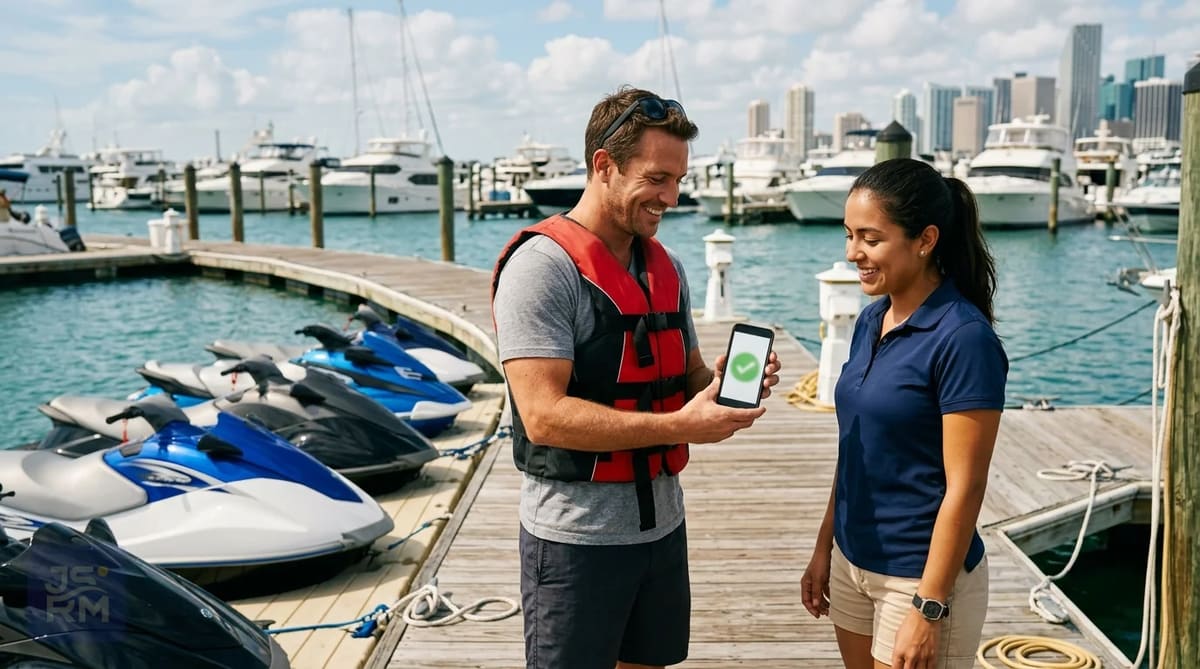
When you show up at the marina in South Beach, Key Biscayne, or another Miami-area launch point, you present your passing score on your phone screen alongside your government ID. Screenshots and PDFs are both accepted.
Arriving with your safety card or temporary certificate already saved to your digital wallet keeps registration fast. For pickup logistics on any specific rental, see the listing page you booked or the operator's confirmation email.
Enforcement and fines on Miami waterways
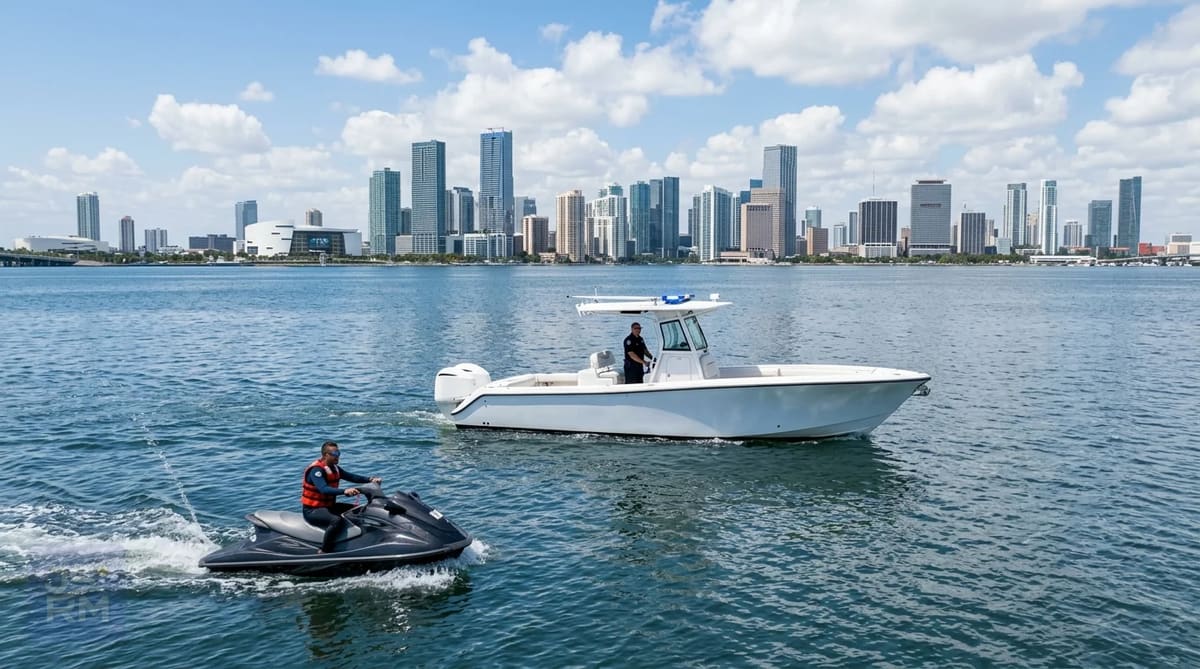
Marine law enforcement on Biscayne Bay is active year-round. The Florida Fish and Wildlife Conservation Commission, the U.S. Coast Guard, Miami-Dade Police Marine Patrol Bureau, and City of Miami Police share jurisdiction over local waters. They conduct regular checks near popular gathering spots like the Haulover Sandbar, Monument Island, and Nixon Beach.
Operating a vessel without your required safety card or photo ID is a non-criminal infraction. The fine per Fla. Stat. § 327.395(6) is up to $50 for a first offense, which the court can dismiss if you complete the safety course within 30 days. A second or subsequent offense is at least $250, plus local court costs. More importantly, law enforcement officers will not allow an uncertified driver to continue operating. They will order you to switch drivers or escort your watercraft back to the ramp, effectively ending your trip early.
Beyond avoiding fines, the material covered in the safety course protects you from real hazards on South Florida waters. Biscayne Bay features narrow channels, busy commercial shipping lanes near PortMiami, low-tide sandbars, and unpredictable afternoon thunderstorms during summer months. Knowing how to read green and red navigation markers, handle crossing situations, and navigate slow-speed manatee zones keeps you safe and confident on the water. Our collection of boating guides covers additional pre-trip planning topics.
Disclosure
Jet Ski Rentals of Miami may earn a small commission if you purchase a boating certificate through BoatTests101 using our link. This does not change your price. We only recommend services relevant to our rental customers.
Primary sources
Florida statutes
Fla. Stat. § 327.395 (Boating safety education requirements): https://www.flsenate.gov/Laws/Statutes/2024/0327.395
Fla. Stat. § 327.39 (Personal watercraft regulations): https://www.flsenate.gov/Laws/Statutes/2024/0327.39
Fla. Stat. § 327.54 (Vessel liveries, safety regulations, penalty): https://www.flsenate.gov/Laws/Statutes/2024/0327.54
Regulatory agencies
Florida Fish and Wildlife Conservation Commission, Boating Safety Education ID Card: https://myfwc.com/boating/safety-education/id/
Florida Fish and Wildlife Conservation Commission, Approved course providers: https://myfwc.com/boating/safety-education/courses/
U.S. Coast Guard, Merchant Mariner Credential: https://www.dco.uscg.mil/nmc/merchant_mariner_credential/
Miami-Dade Police Department, Marine Patrol Bureau: https://www.miamidade.gov/global/police/about-special-patrol-bureau.page
Approved course providers referenced
BoatTests101 (Florida Temporary Certificate, $13.95): https://boattests101.com/united-states/florida/florida-rental?mcid=iIGeNl2s
BoatTests101 (Florida Lifetime Certificate, $39.95):
https://boattests101.com/united-states/florida?mcid=09Yxd0UA
Book a jet ski near Miami
Frequently Asked Questions
Do I need a boating license to rent a jet ski in Miami?
Florida does not issue a boating license, but if you were born on or after January 1, 1988, you must have a Florida Boating Safety Education ID Card or a 90-day temporary certificate to operate a jet ski.
How long does it take to get a Florida boating safety card online?
The permanent online course takes between 3 to 6 hours to finish. You can complete it all at once or break it up into shorter sessions across several days on your phone or computer.
Is the Florida boating safety course free?
Yes, the BoatUS Foundation provides a free online course approved by the FWC. Other private providers like Boat-Ed charge between $30 and $35 for enhanced interactive features and video modules.
How long is a Florida temporary boating certificate good for?
A temporary certificate is valid for 90 days from the issue date. It is designed for short-term visitors and tourists renting boats or jet skis in Florida.
Can I use an out-of-state boating card in Florida?
Yes, Florida accepts valid boating safety cards from other U.S. states and territories as long as the course is officially approved by NASBLA.
What happens if I get caught driving a boat without a card in Miami?
Operating a vessel without required proof of certification is a civil infraction. You face monetary fines starting at $50 plus court fees, and officers will prohibit you from continuing to drive the vessel.
Comments (0)