Jet Ski vs WaveRunner: The Real Difference Explained
Two trademarks, two engineering philosophies, and what each one actually feels like on Biscayne Bay

Jet Ski is Kawasaki's trademark for its personal watercraft and WaveRunner is Yamaha's. The U.S. Coast Guard classifies both simply as personal watercraft. Kawasaki builds heavy deep-V hulls with inline four-cylinder engines and a thumb-trigger reverse, while Yamaha builds lighter NanoXcel hulls with purpose-built marine engines and a two-lever RiDE control. Most Miami rental fleets, including ours, run Yamaha WaveRunners.

Planning your Miami water adventure? Discover our jet ski rental in Miami or try our Miami Beach jet ski and boat rentals.
Understanding the difference between jet ski and waverunner
People use "jet ski" for any small motorized watercraft you sit or stand on. Calling every watercraft a Jet Ski is like calling every tissue a Kleenex. The real difference between a Jet Ski and a WaveRunner is who builds them, and how each company engineers the engine, the hull, and the controls.
Jet Ski is the registered trademark for personal watercraft built by Kawasaki. Kawasaki entered the commercial watercraft market in the early 1970s with solo stand-up models. WaveRunner is the trademarked name for personal watercraft built by Yamaha Motor Corporation, which launched its first sit-down, open-stern model in 1986. Both machines use an internal jet pump that draws water in and blasts it back out through a steerable nozzle. Almost everything else about them is different.
Regulators ignore brand names entirely. The U.S. Coast Guard and state agencies classify both as a personal watercraft: an inboard vessel under 16 feet that uses an internal combustion engine driving a jet pump as its primary source of propulsion.
Knowing which name belongs to which manufacturer matters when you buy a craft or order parts. It matters less when you rent, because most rental fleets standardize on a single brand.
Brand origins and company history

Kawasaki and the birth of the Jet Ski

Kawasaki introduced the JS400 in 1973, after acquiring rights to an early solo watercraft concept from inventor Clayton Jacobson II. For nearly fifteen years it built solo stand-up models almost exclusively. Riders stood on a flat tray and steered with a hinged handlepole, and staying upright took constant balance and body positioning.
As demand shifted toward group outings and family trips, Kawasaki expanded into sit-down multi-passenger models. The brand became known for high top speeds and heavy deep-V hulls. It still builds both ends of that range today: the stand-up SX-R 160, and three-passenger touring units like the Ultra 310LX with its supercharged four-cylinder engine.

Yamaha and the development of the WaveRunner
Yamaha entered the watercraft market in 1986 with the WaveRunner WR500. It was a sit-down craft with an open stern and a trailing step platform, so a rider who came off in deep water could climb back on from behind. That one design decision is what turned watercraft riding from an athletic pursuit into a mainstream family sport.

Yamaha concentrated on fuel efficiency and hull ergonomics. Its high-output HO and SVHO engines are purpose-built marine units rather than adapted motorcycle blocks, though the smaller TR-1 does trace its architecture back to the R1 motorcycle line. Those engines paired with composite hulls made Yamaha the reference point for touring comfort and offshore stability.

Sea-Doo and the wider personal watercraft market
Kawasaki and Yamaha own the two most recognizable names, but Bombardier Recreational Products builds Sea-Doo, the third major share of the personal watercraft market. Sea-Doo launched a model in 1968, left the market, and came back in 1988. Its craft use Rotax engines, closed-loop cooling, and Polytec composite hulls. Anyone weighing a Jet Ski against a WaveRunner tends to end up looking at Sea-Doo as well, usually because of its Intelligent Brake and Reverse system.
Engine design and cooling technology differences
Kawasaki builds around inline four-cylinder four-stroke engines. Many current Jet Ski models share a 1,498cc platform. Naturally aspirated, as in the STX 160, it makes about 160 horsepower. On the supercharged Ultra 310 series Kawasaki adds an Eaton TVS roots-type supercharger and an intercooler to reach 310 horsepower. The payoff is throttle punch and top-end speed. The cost is premium fuel and a supercharger drive belt that has to be inspected on schedule.
Yamaha starts with the TR-1, a 1,049cc three-cylinder engine chosen for light weight and fuel economy. Its performance models use the SVHO (Super Vortex High Output), a 1,812cc supercharged four-cylinder. Yamaha drives that supercharger with a gear off the crankshaft through a clutch pack, so there is no drive belt to replace. The clutch washers are the wear item instead.
Cooling architecture is the other split between the three brands.
Yamaha WaveRunners use open-loop cooling. The jet pump pulls raw water straight from the lake or ocean and circulates it through cooling jackets in the engine block before discharging it through the exhaust bypass. The design is simple and light, and it demands a thorough freshwater flush after every saltwater ride.
Kawasaki Jet Skis also run open-loop cooling across most of the lineup, using raw water from the jet pump to hold engine temperature during high-rpm operation.
Sea-Doo runs closed-loop cooling. Coolant circulates through the engine block and sheds heat through a ride plate mounted on the bottom of the hull. Raw ocean water never enters the block at all, which cuts internal corrosion risk in coastal use.
Hull materials and water handling comparison
Kawasaki builds deep, heavy hulls that cut through chop with very little deflection. The Ultra hull carries a 22.5-degree deep-V deadrise, which slices through ocean swell and wind chop and feels planted underneath you. The trade-off is mass. A fully fueled Ultra 310LX comes in near 1,090 pounds on the trailer, which means a capable tow vehicle and real effort moving it by hand at the ramp.
Yamaha went the other direction, using engineered composites to hold weight down without giving up stiffness.
SMC fiberglass is traditional Sheet Molding Compound, used on heavy-duty touring platforms. It is durable and straightforward to repair after localized damage.
NanoXcel uses a proprietary nanotechnology resin that takes roughly 25 percent off the weight of SMC at comparable strength.
NanoXcel 2 is lighter again, about 18 percent below NanoXcel, and appears mainly on FX SVHO and GP1800R models where power-to-weight and cornering response matter most.
Yamaha hulls also run a slightly flatter V-entry than Kawasaki's deep-V. A WaveRunner planes out sooner and turns more willingly on calm to moderate water. In heavy chop the lighter hull bounces more than a heavy Ultra does, and in exchange it accelerates harder and burns less fuel.

Brake, reverse, and electronic control technology
Stopping a watercraft used to be genuinely difficult, because jet propulsion needs water moving through the pump to steer at all. Early models had no brakes and used a mechanical reverse bucket the rider hauled on with a lever near the footwell. Electronic controls have since changed how riders slow down, dock, and back off a ramp.
Yamaha's RiDE system (Reverse intuitive Deceleration Electronics) puts two levers on the handlebars. The right lever is forward throttle. The left lever handles deceleration and reverse. Pull the left lever at speed and the craft drops its reverse bucket to redirect thrust forward, which slows you down without burying the nose. Pull both together and it holds neutral. The whole thing runs through the ECU with no mechanical cables, which is what makes low-speed docking so easy.
Kawasaki's KSRD (Kawasaki Smart Reverse with Deceleration) uses a thumb trigger on the right handlebar instead. Press the trigger and the reverse bucket deploys to slow or reverse the craft. It works well, but the thumb-trigger layout takes more practice than a two-lever setup, particularly for anyone coming off a WaveRunner.
Sea-Doo's iBR (Intelligent Brake and Reverse) uses a left-handlebar lever much like Yamaha's. It lets the craft start in neutral and applies an electronic brake. BRP's own testing puts the stopping distance up to 160 feet shorter from top speed than a craft with no braking system at all.

Stand-up versus sit-down models
The naming confusion shows up here too. For decades, "jet ski" meant a solo stand-up machine and nothing else.
Kawasaki still commits to that market with the Jet Ski SX-R 160. It runs the naturally aspirated 1,498cc engine, weighs about 550 pounds ready to ride, and stretches over eight feet, which makes it far larger than the two-stroke stand-ups of the 1990s. It rewards buoy racers and experienced solo riders with speed and stability. It also asks you to balance constantly on the tray, and climbing back on in deep water is hard physical work.
Yamaha's stand-up is the SuperJet. Two-stroke emissions rules kept it restricted to professional racing for years, until Yamaha rebuilt it around the four-stroke TR-1 three-cylinder. The current SuperJet is lighter than the SX-R 160, and its wider deck makes learning to ride stand-up less punishing.
Sit-down models from both brands seat two to three riders and add large storage compartments, touring seats, cruise control, and marine stereo options. Towing a wakeboarder, running out to a sandbar, or spending a full day on the water all point to a three-passenger sit-down WaveRunner or Jet Ski.

What the difference looks like on Biscayne Bay
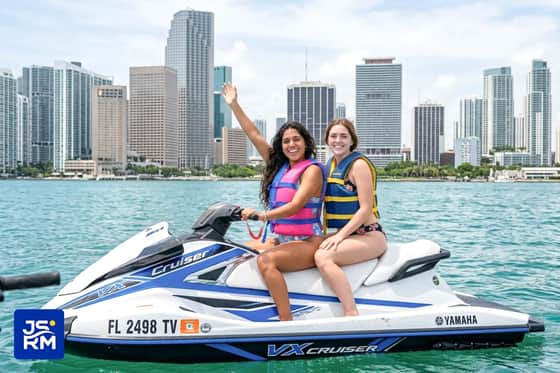
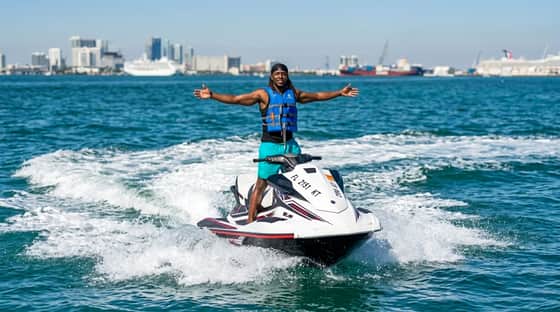
Our Miami fleet runs Yamaha WaveRunners, so the rest of this section is what we watch happen on the water rather than what a spec sheet promises.
Biscayne Bay is shallow and mostly protected, and on a calm weekday morning the flat-water advantage of a lighter Yamaha hull is exactly what you feel. It gets on plane immediately and turns without arguing. That changes by early afternoon. Once the sea breeze fills in and boat traffic builds through the channels off Miami Beach, the chop turns short and steep, and a light hull starts skipping across the tops of it instead of cutting through. A heavy deep-V Kawasaki tracks through that same water more calmly. Head out past Government Cut into open ocean swell and the weight stops being a penalty and becomes the entire point.
The other difference riders notice inside five minutes is the controls. The two-lever RiDE layout is the easiest thing to teach a first-time rider, because slowing down uses the same hand motion as a bicycle brake. Most first-timers have it worked out before they leave the no-wake zone.
If you would rather feel the difference than read about it, a one-hour ride on Biscayne Bay is the cheapest way to test the ergonomics and control layout before committing to a purchase. For current pricing and what is included, see the jet ski tour out of Key Biscayne.
Maintenance demands, fuel usage, and ownership costs

Saltwater flushing protocols
Both Kawasaki and Yamaha open-loop systems need a freshwater flush after every ride in ocean or brackish water. Salt and sand collect fast inside the narrow cooling passages of the block. Attach a garden hose to the flush fitting on the rear deck, start the engine first, then turn on the water, run it about three minutes, turn the water off, and only then shut down the engine. Running water through a stopped engine can flood the exhaust manifold and push water back into the cylinders, which is how people destroy an engine while standing at the dock.
Supercharger inspection and maintenance
High-output models need their own attention. Supercharged Kawasaki engines drive the blower with a belt, so the belt and its tensioner need periodic inspection and replacement on the factory schedule. Supercharged Yamaha SVHO engines use a clutch pack instead, and those clutch washers wear down and need checking before they start slipping under load. Naturally aspirated engines like the Yamaha TR-1 or the Kawasaki STX 160 avoid both jobs and cost less to keep running.
Fuel consumption profiles
Fuel burn depends on displacement and on how hard you hold the throttle.
Naturally aspirated three-cylinder models: roughly 3 to 5 gallons per hour cruising between 25 and 35 mph.
Naturally aspirated four-cylinder models: around 6 to 8 gallons per hour at moderate cruising speeds.
Supercharged models like the Ultra 310 or FX SVHO: over 20 gallons per hour of premium fuel when held near their 67 mph limiter.
Choosing between a Jet Ski and a WaveRunner
Consider a Kawasaki Jet Ski if you want:
Rough-water performance that stays composed in ocean chop.
Hard acceleration and high top-end power.
A heavy hull that stays planted at speed offshore.
A stand-up machine with real racing heritage, like the SX-R 160.
Consider a Yamaha WaveRunner if you want:
The two-lever RiDE braking and reverse layout, which is the fastest to learn.
Lightweight NanoXcel hulls that accelerate quickly and turn sharply.
Purpose-built marine engines in the HO and SVHO range.
Wide touring seats and deck space for long multi-passenger days.
Licensing does not depend on which brand you pick. In Florida, anyone born on or after January 1, 1988 has to carry a Florida Boating Safety Education ID Card to operate a vessel with an engine of 10 horsepower or more. The minimum age to operate a personal watercraft is 14, and rental operators generally require whoever signs the agreement to be 18. Our walkthrough of how to get your Florida Boating Safety Education ID Card online covers the approved courses, the temporary certificate, and what to carry with you on the water.
Sources
| Category | Kawasaki Jet Ski | Yamaha WaveRunner | Sea-Doo |
|---|---|---|---|
| Manufacturer | Kawasaki | Yamaha Motor Corporation | Bombardier Recreational Products |
| First model | JS400, 1973 | WaveRunner WR500, 1986 | 1968, relaunched 1988 |
| Engine platform | 1,498cc inline four; supercharged to 310 hp on the Ultra 310 | 1,049cc TR-1 triple; 1,812cc supercharged SVHO four | Rotax, naturally aspirated and supercharged |
| Supercharger drive | Belt-driven Eaton TVS; belt is a scheduled wear item | Gear-driven off the crank through a clutch pack; clutch washers wear | Rotax supercharger with its own service interval |
| Cooling | Open loop, raw water through the block | Open loop, raw water through the block | Closed loop, ride plate acts as heat exchanger |
| Hull material | SMC fiberglass, heavy deep-V | SMC, NanoXcel, NanoXcel 2 composites | Fiberglass and Polytec composite |
| Hull character | 22.5-degree deadrise; planted in ocean chop | Flatter V-entry; planes early, turns sharply | Varies by platform; light Polytec hulls on entry models |
| Brake and reverse | KSRD, thumb trigger on the right handlebar | RiDE, dual handlebar levers | iBR, left handlebar lever, starts in neutral |
| Stand-up model | SX-R 160, about 550 lb ready to ride | SuperJet, four-stroke TR-1 | None in the current lineup |
| Typical flagship weight | Ultra 310LX, near 1,090 lb | FX SVHO, lighter via NanoXcel 2 | Mid-range between the two |
| Saltwater routine | Freshwater flush after every ride | Freshwater flush after every ride | Flush the exhaust; no raw water in the block |
Book a jet ski near Key Biscayne
Frequently Asked Questions
Is a WaveRunner a Jet Ski?
Not technically. Jet Ski is Kawasaki's registered trademark and WaveRunner is Yamaha's. Both are personal watercraft, which is the term the U.S. Coast Guard and the State of Florida use. People say "jet ski" for all of them the way they say "Kleenex" for all tissues.
Which is better, a Jet Ski or a WaveRunner?
Neither is better across the board. Kawasaki Jet Skis have heavier deep-V hulls that stay composed in ocean chop and strong top-end power. Yamaha WaveRunners are lighter, plane sooner, turn more sharply on calm water, burn less fuel, and use a two-lever control layout that first-time riders learn fastest.
Do jet skis have brakes?
Modern ones do. Yamaha's RiDE system uses a left handlebar lever that deploys the reverse bucket to slow the craft. Kawasaki's KSRD uses a thumb trigger on the right grip. Sea-Doo's iBR adds a true electronic brake. Older models had no braking at all and relied on the rider letting off the throttle.
Why do most rental companies use Yamaha WaveRunners?
The two-lever RiDE control is the easiest system to teach a beginner, the lighter hull handles flat protected water like Biscayne Bay well, and the naturally aspirated TR-1 and HO engines cost less to fuel and maintain than supercharged units. Our Miami fleet runs Yamaha WaveRunners for those reasons.
Do you need a license to ride a jet ski in Florida?
Anyone born on or after January 1, 1988 must carry a Florida Boating Safety Education ID Card to operate a vessel with 10 horsepower or more, and a personal watercraft operator must be at least 14. The card can be earned online in a few hours. Rental companies generally require the person signing the agreement to be 18.
Which is faster, a Jet Ski or a WaveRunner?
Top supercharged models from both brands are electronically limited to about 67 mph. The Kawasaki Ultra 310 makes 310 horsepower and the Yamaha FX SVHO makes around 250, but the Yamaha weighs less, so real-world acceleration is close. Naturally aspirated models from either brand top out in the low 50s.
Comments (0)